Saturday, September 19, 2009

Forgotten Realms in the 4th Edition of D&D


So, I understand why WotC is focusing more on building a Campaign Guide and a Player's Guide for the worlds they'll support, with minimal modules and additional setting books. (A completist at heart, even I gave up on owning all the FR materials during the mad rush of 3.5E D&D.) But, that said, I do somewhat miss the support materials to expand upon what's in the campaign settings. Is the 4 pages of content about Cormyr from the Campaign Guide going to be all that the largest of the Realms' kingdoms will get during 4th Edition? (with the exception of D&D Insider articles, that is) I'm having fun taking advantage of this void of information by digging back into my archives, even into the Volo's Guides. If you never read the Volo's Guides, think "Let's Go Forgotten Realms" or a Zagat's guide - starred reviews of the inns and locales of the Forgotten Realms, written by the Realms' most notorious bard/vagabond, with lots of plot hooks inserted here and there (as well as "corrections" from the ever accurate Elminster the wizard...)

What campaign support materials do you use when prepping a campaign?

Saturday, September 12, 2009

Auditing the Dungeon Master's Guides


I'm getting back into the DM's seat for Dungeons & Dragons after almost a year hiatus. (I've spent my time playing D&D, and running Runequest and other games over the past many months, and will continue to do so. Halloween Cthulhu is just around the corner!) I'll be running 4th Edition D&D at my friends' comic book shop for regularly scheduled games, with Forgotten Realms as the campaign setting (the setting I've been running in pretty regularly for about 20 years, with the occasional side trek to Ravenloft, Greyhawk or Eberron).

In prep for the games, I've been scouring my years and years worth of Forgotten Realms supplements for adventure hooks, encounter sites, plots and NPCs. In my humble opinion, the Realms run best as a sandbox, rather than something where the players are led by the nose into a large metaplot. (I'm still trying to understand how TSR thought having the Horde or the Times of Troubles as playable encounters in the 90s was a wise idea... Unless the PCs are driving the action, having them suckered into large campaigns as bystanders - soldiers in the army, instead of instigators - can make for a difficult scenario to DM...) So, to create the best Realms sandbox that I can, I've been leaning on a lot of the campaign resources, but also on decades' worth of Dungeon Master's Guides. It's kind of wild to see how this product has evolved over the years.
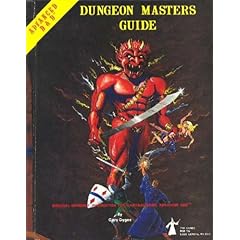
  • The First Edition DM's Guide, of which I do not have the fancy one pictured above, but instead the yellow spined edition that had some revisions to it, was a stream of consciousness walk through gaming philosophy, tables of random items and dungeons, and much much more. Not a practical guide by any stretch (not even its champions, myself included, would claim that) it was instead basically a brain dump by Gary Gygax of how gaming ideally works. Much fun is the random dungeon generator for solo play, as well as the artifcats that are still finding themselves used in games today.
  • The Second Edition DM's Guide was the weakest of the bunch. Neutering D&D to make it "adventure without danger" in reaction to a lot of the pressures of the 80s about the evils of roleplaying games (I'm using fairly broad strokes here - there were a lot of other factors to the revision), 2nd Edition started the trend of making the DMs guide slimmer than the Player's Handbook. Put the rules in the PHB, put the philosophy and commentary in the DMG. But, sadly, there was little of that in the 2nd edition guide, focusing more on magic items, etc.
  • The 3.5E DM's Guide (I don't have the 3e one), took a step back to offering more in the way of guidance, including a chart of 100 plot hooks that I still use, lots of advice about running games and creating adventures, as well as tons of info about how to DM. I think it may be the best of the WotC/TSR DM's guides.
  • The 3.5E Dungeon Master's Guide II, which I couldn't lay my hands on in the past few days - must be in a box somewhere, was a fantastic resource. Taking the 1E village of Saltmarsh and expanding it, building plot hooks for months of adventures, and statting out so much of it was tremendous. Perhaps even better was the advice on how to make a world living and breathing, including how to build out official factions. Now was this likely in reaction to what was happening in the video game world with factions as a way to relate to a game world? (See Oblivion, WoW, etc.) Likely yes, but the way to enact it for a tabletop RPG as well done, and made it something I started trying to do more and more of with the Ptolus campaign I was running when I purchased this book.
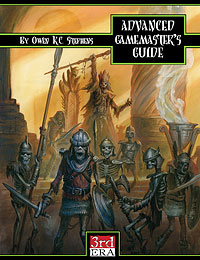
  • Not an official TSR/WotC product, but noteworthy nonetheless was Green Ronin's Advanced Gamesmaster's Guide. (Full disclosure - I playtested this for Green Ronin, and felt right from the start that it was going to be a fantastic product.) There was more keen advice in here than in any other product I'd seen to that point about how to be a good DM. Not just the stuff about "here's how to prep a published adventure," but stuff about roles in the playing group and how to address particular needs that different player types might have, how to craft scenarios to different play styles, and lots of great ideas for NPC behavior, plot hooks, and more. Great, great stuff.
  • Lastly, the 4th Edition DM's Guide. Now, I've been kind of hard on 4e. I still feel like the overall focus of making a game that is more relevant to the World of Warcraft gang (of which I'm happy to be an on-again-off-again member) takes away from the fun of "play" that previous editions had. ("Do you want to be a wizard or a fighter?" has been replaced with "Do you want to be a controller or the tank?" as I've stated before.) That said, the DM's guide does a good job in going over the mechanics of being a good DM - how to build good encounters, how to build quests, etc. I feel the overall system itself is too focused on the mechanics of 10 encounters are needed to level, and here's what should be in those encounters, and that sort of metagaming, but the result is what you make of it. I'm going to work hard to make a 4E sandbox where it's about the characters, not the stats and artillery roles. The way the book closes, with the introduction of the town of Fallcrest as an adventure starting point, does a good job to show what the game can be, and I hope more and more DMs embrace that.
I'm looking forward to a very role heavy version of roleplaying through the Forgotten Realms, in my new campaign. (No munchkins allowed, folks!) I'm also looking forward to the 4th Edition DMG II that is due out, focusing on running campaigns for characters levels 11-20. Bring it on WotC! I got some dice and am ready to game!

Thursday, September 10, 2009

Runefang by C.L. Werner (Warhammer Fantasy Fiction)


While flying to and from England, last month, I read C.L. Werner's Runefang, one of the Warhammer Fantasy titles published by Black Library. My exposure to Warhammer Fantasy has been a long one, dating back to the table top game that I started playing - er well, at least painting minis for - in the early 90s, and into my introduction to the Fantasy RPG through my friend Travis in the earlier part of this decade. I've read all of the Gotrek and Felix novels, as well as some of the lower profile titles released over the past few years. Runefang was a well done addition to the canon, being a title that expanded upon the world of Warhammer. Gorbad Ironclaw, Gordreg Throatripper and Uhrghul Skullcracker, two of the game's orc legends, were introduced as characters in the novel, marauding orcs who led hordes across the world. In the midst of the maelstrom of these orc invasions (spread across several generations) were attempts to wield a magical sword called the Runefang to defeat the tide of monsters descending upon civilization, albeit a dark and hopeless civilization, unlike the shinier safer worlds of many other mainstream fantasy series like Ed Greenwood's Forgotten Realms and others.

The world of Warhammer is not a place where tidy and charming wizards pop up at the last minute to save the day - I actually lost count of the number of primary and secondary characters that died during Runefang. That, I think, is the key piece about Warhammer Fantasy, and what works and doesn't work for it as a shared world of fiction. The world itself is immense and much more like the "points of light" idea that Wizards of the Coast is trying with the Forgotten Realms now - the idea that society in between the outposts of civilization in a fantasy world is a harsh, cruel place without much amenities or even safety. Werner did a great job with painting that image in Runefang, wherein a Dirty Dozen style motley crew of characters are sent on this suicide mission to retrieve this magical sword from a long lost outpost across the barony where the story unfolds. There are bandits, orc tribes, rival factions in the court who would not like to see the (anti-heroes) succeed, and more. But Werner balances this with some hope and some heroism, which is more than I can say for what some of the other Warhammer titles are able to carry out. Particularly Elfslayer, the latest in the Gotrek and Felix series, and the other dark elf titles, seem to border on exploitation rather than "dark fantasy". Knowing that a village was razed by vicious marauders should be enough for the readership of the novels, without details of the torture and pillage. I know there's a market for very dark fantasy, but I do have some concern that the readership of novels based on a tabletop game played by young people may not be the place for exploring this territory. (Wow, never thought I'd sound like an old fogey like this.)

Warhammer titles that I thought did a good job of expanding upon the Warhammer world in a fashion that I thought lent more to the overall "shared world" include:
  • All of the William King Gotrek & Felix titles, as well as the first couple by Nathan Long (Orcslayer and Manslayer)
  • Fell Cargo by Dan Abnett
  • The Adventures of Florin and Lorenzo by Robert Earl
  • The Enemy Within by Richard Lee Byers
  • Mark of Chaos by Anthony Reynolds
Weigh in below on the comments thread if you have thoughts about any of the other Warhammer Fantasy books.

Monday, September 7, 2009

John Madden DM (with thanks to RPG Blog II)

Saw the below over on RPG Blog II, and couldn't resist sharing it via my own pages as well... Tis the time of year to enjoy football, role playing games and other indoor pursuits. (well, I guess football takes place outdoors, but I like to watch it from the comfort of my couch...)


Tuesday, August 11, 2009

The passing of my father

My father, the man who raised me, taught me, and introduced me to so many wonderful things - hiking, philosophy, poetry, gaming, carving, and painting, amongst many other vocations - passed away. Such times as these when I've lost a close friend and cherished mentor, before, have caused me to think of e.e. cummings' poem 'Buffalo Bill'...


Buffalo Bill's
defunct
who used to
ride a watersmooth-silver
stallion
and break onetwothreefourfive pigeons justlikethat
Jesus
he was a handsome man
and what I want to know is
how do you like your blue-eyed boy
Mister Death

Monday, August 3, 2009

I got me some Google Juice

The G.I. Joe DVDs were awesome, but hey dig this!

I got me a Google Voice account, and Google also just mailed me a laminated set of directions for GMail (Become a GMail Ninja). I don't know how I got on the Golden Ticket list, but daaang! I feel the love, Skynet. I feel the love.

If you haven't seen the GMail Ninja thing, check out the link. Didn't know I was already about 80% there to being a GMail Ninja, but the list of tips and tricks helped me close the gap.

But the serious Google Juice is in the Google Voice account. The ability to send texts from my browser, have a phone number that rings all the numbers I want it to ring throughout the day (my work phone during work hours, my cell while I'm at lunch, etc.), the ability to have some contacts ring to certain phones and others to other lines, the ability to set up customized voicemails (have all the folks in my gaming group always get a voicemail message that states the dates of the next 3 games, but have the work folks get a brief "leave a message"), and the list goes on...

So cool. Thank you Willy Wonka! I will keep drinking the google kool aid; just keep the loot coming! :)

Friday, July 31, 2009

The Forgotten Realms in 4E: The Literature

I just finished reading Bruce R. Cordell's Plague of Spells (1385 DR - 1396 DR) and Richard Baker's Swordmage (1477 DR - 1479 DR), two of the earlier books in The Forgotten Realms pantheon to be set after the Spell Plague, which serves as the high water mark between the 3rd and 4th edition continuities of the classic shared fiction world. Other titles have covered the FR since the switchover to the new edition of Dungeons & Dragons, but these books opened up the first two big story arcs of the new era - The Abolethic Sovereignty and Blades of the Moonsea, respectively. In the non-literary world, I'm about to start my first 4th edition game of D&D set in the Forgotten Realms, starting a sandbox game in the Moonsea area using the 4e Forgotten Realms Campaign Setting and Player's Guide to the Forgotten Realms.

So, how are the books, and how do the help define the FR in 4E? Both were good, and in different ways. Cordell's Plague of Spells, the earlier set of the two titles, does perhaps the best job of explaining the Spell Plague of any of the texts I've read so far about 4th edition. He makes the experience of the (massively magically overpowered) world coming to an end and a new less pleasant world taking over seem real. Additionally, he does a great job making the characters more three dimensional than many other genre fiction titles, making Raidon's loss of a child something that sticks with the reader, Anusha's coming of age reminiscent for many of us, and Japheth's drug addiction a little more realistic than many books of its ilk might want to address. From both a game mechanics perspective and a literary perspective the apocalyptic removal of magical power from many of the Forgotten Realms' prominent figures helps address a problem this setting had suffered
under for over a decade - if there's a world full of massively overpowered beings, why would any other heroes be needed? (I know, but who will watch the watchmen?) Taking the power players down a peg helps give the other figures (player characters in the game, new characters in the books) take shape. The thing that I think Cordell did rather well within his book was keeping a few touch points from the earlier setting to help bridge the gap between "the old world" and the new era. Amongst these were characters from his book Stardeep, about a dungeon within the realms, and also cities and gods from the older campaign. Japheth as a young monk from Candlekeep before the fall was an interesting twist. (What happens to the folks who have spent their lives cataloging magic and knowledge when the world of magic shatters? Well, some would lose their way...)

Swordmage was a different animal. Set much further after the end of the spellplague, it was less concerned with how we got here, and much more about where we are now. There are still touchpoints back to the older setting - info about gods' names that had changed, cities that had been 3rd rate to Waterdeep are now larger players, the Elven kingdom of Myth Drannor has become whole again - but there are also some wholly new elements, like embedded pieces of the planet's lost sister world Abeir. The investigative plot line of SwordMage is fairly reminiscient of many of the stories associated with the Eberron campaign and literary setting. Eberron, the campaign world created by game designer Keith Baker, is a world of pulp mystery - think Chinatown with orc thugs and protagonists that are loners who reluctantly investigate murders. Geran, the main character in Swordmage, is a child of privilege who of course leaves all of that behind to travel the world. In his travels, he becomes entangled in scandal in the Elvish land of Myth Drannor, and after wandering for a while as an adventurer comes home to Hulburg, the kingdom ruled by his elderly uncle. Yes, this is the set up for every Princess Bride-esque tale to be told with Dungeons and Dragons as the mechanics for the telling, but Richard Baker does some clever things to not just tell the story, but make the reader interested in the new campaign world that the game is set in. It's no coincidence that the Forgotten Realms Campaign Setting opens with descriptions of the Moonsea area, where this novel is set, I'm sure. It also leaves enough plot hooks and introduces enough characters (NPCs in game parlance, for the uninitiated) to make for enough tales told around the game table using this novel as source material, much like many 1st edition gamers leveraged the Moonshae Isles books by Douglas Niles to start the first games based in the Forgotten Realms, more than 20 years ago. (Yes, I was one, sitting in my parents' living room after Christmas, and opening the gray box of the first FR Campaign Setting, and rolling up stats for NPCs while listening to Queen, with either the Niles books and the first R.A. Salvatore books, well dog eared by that point, within reach.)

The books are both worth reading, if you liked the FR books of years past or if you're planning on playing in or running a FR game that uses the 4th Edition setting. Cordell's book does a nice job of bridging the gap (I understand one of Salvatore's latest does a similar job), and Baker's Swordmage helps define one of the campaign areas that many players will rediscover this world through - the Moonsea. Both do the genre fiction world justice, and are better than other similar releases in other series. Most importantly, they keep a campaign world that had been stagnating a bit in recent history viable, and take it in new directions. I'll see you in the Realms.

Wednesday, July 29, 2009

I am the Luckiest Man in the World

So, I'm driving to work, the other morning, listening to the local rock station, and the DJ says, "After the break, we'll have something special for fans of the 1980s cartoon, G.I. Joe..." With baited breath, I pulled over and dialled in after they announced that some lucky winner would get a boxed DVD set of G.I. Joe Season 1.1, and lucky me, I was caller 7. As one of my friends said, "Tyler, what's the phrase that pays?" Well, WNNJ, you're my hero.


Things I had forgotten about G.I. Joe since childhood:
  • The COBRA Temple looks like something out of Indiana Jones and the Temple of Doom, mixed with a Stygian temple from Conan...
  • That G.I. Joe will always "return after these messages..."
  • COBRA Commander and Destro employ the same mind controlling headbands that Ming the Merciless used in the Flash Gordon serials, about 50 years earlier...
  • Destro had a Cthulhoid background...
  • Major Bludd looked way more badass than he sounded (was the voice actor an evil cartoon mouse on another show?)
  • Snake Eyes was way more badass than he looked.
  • Bullets never hit anything except for inanimate objects
  • There are not enough acronyms in the world
  • Sgt. Slaughter was not just a wrestler, he was a Joe
  • Destro controlled possessed Joes with a joystick
  • I still have a crush on The Baronness

Sunday, July 26, 2009

Wrapped up H2: Thunderspire Labyrinth - not as good as Keep on the Shadowfell...

I ran Keep on the Shadowfell for the D&D group that plays periodically at Timewarp Comics & Games, right as D&D 4E was released. The particular d&d group that was playing it there meets roughly once - sometimes twice - a month, so it took us a good 6 months to play through the whole thing. This was during the honeymoon period for me with Fourth Edition, when a lot of the new powers and class permutations seemed pretty novel and exciting. After DMing the game for a few months though, for different players, I started to feel a little differently, feeling that each combat was becoming repetitive. ("I use magic missile." "I use magic missile." "I use magic missile.") It seemed to me that despite the efforts to add new options to character classes, a weakness for some classes from1st Edition had reared its ugly head again - there are courses of action that are far more preferable for certain classes, and you'll use them over and over again, despite having other options. Magic Missile might have been the weapon of choice for a 1st level magic user in 1e because that was the most effective option, but at least by 4th level, you had a lot of other options. In 4E, after a wizard has blown their encounter power(s), they're still using magic missile a heck of a lot, even at level 8 or even higher...

So why did Keep on the Shadowfell work for me, aside from the honeymoon stage piece? Well, it was a well done module with lots of hooks for encounters and NPCs that weren't fleshed out. It was vaguely reminiscent of T1: The Village of Hommlet from early AD&D, in that the town itself was just as much the adventure as the encounters themselves - meet the town wizard, meet the innkeeper, etc. The end of the mod felt a bit like a railroaded closing to what had been a pretty promising adventure, but that's in my opinion a necessary evil of published adventures - they need to establish closure somehow, and if there are a lot of well defined plot hooks along the way, the closing sometimes can be a bit abrupt or have some urgency to it, just for architecture's sake.
My buddy Josh ran Thunderspire Labyrinth for the same group, though, and my feelings are not the same as they were for Shadowfell. Thunderspire Labyrinth had a lot of potential - the party saves slaves captured by evil Duergar - dark dwarves - in the Underdark, have to fight off a cult associate with an ancient Minotaur temple, and more. That said, this module seemed way more heavy on the encounters and factions that were pretty two-dimensional (we get it - Duergar are evil dwarves...) rather than providing an adventuring environment and NPCs that the PCs really had any interest in protecting. The concept of a town in a mountain was great, but I didn't feel like there were any strong hooks for making this place a home for the PCs - something I always look for in settings (create a place where the PCs wouldn't mind staying, and adventuring some more).

I have a lot of respect for Baker and Mearls, I just felt like after the wide-open, sandbox-y feel of Shadowfell that Thunderspire gave a lot more potential for play outside the pages of the module, whereas Thunderspire Labyrinth had some great scenes and ideas but was more of an adventure to play as a path to completing the Heroic Tier so that you could get on with the Paragon stuff.

We're going to play a sandbox game of Forgotten Realms as the next game with this group. I'll be DMing, and the party will find themselves in the Moonsea, leveraging a lot of the things I thought Baker has done well with the Swords of the Moonsea series, and giving the players an open ended world to play in.

What'd you think of H1 and H2? Is H3 worth incorporating into our game? Interestingly, I've seen lots of folks say they thought H2 was far better than H1. Discuss!

Saturday, July 25, 2009

Roleplaying Games that are good to play 1 on 1?

No, not a return to my gamebook posting, from a few months back. My buddy Josh is coming over this afternoon for some gaming (and steak, but that's another blog...). We could play some runequest, I suppose, as his character is the protagonist for the RQ campaign I've been running, or we could just play a boardgame or card game, but we're in the mood for roleplaying. What games work effectively for a DM and player, in your opinion?

Ones that spring to mind for me are:
  • Call of Cthulhu - most of Lovecraft's stories were about sole individuals, not parties
  • Kobolds Ate my Baby - Beer and pretzels roleplaying at its best, and the adventures of a rogue kobold are always good for a few laughs
  • OD&D - the original red box still plays well one on one - heck, I've got a bunch of Expert level mods from the 80s that were intended for just one player and one dm
  • Eberron D&D 3.5 (waiting to try out 4e Eberron) - the film noir aspects of this D&D setting lent themselves well to lone detective games (heck, I lifted a ton of plot hooks for my eberron games from everything from Chinatown to classic pulp serials - Flash Gordon worked VERY well for the fragmented nations of Eberron...)
  • I'd say Magic: The Gathering, but thanks to Jim at Timewarp Comics, I sold my collection of cards years ago - thanks, man! you helped me kick the habit!
Any ideas? Want to share some stories of one-on-one games you've played?