Showing posts with label forgotten realms. Show all posts

Friday, September 17, 2010

Gaming at the Shop

I've been spending a lot of time over the Summer and into early Fall running games of D&D at the shop and watching folks play 40k (learning by osmosis). Last weekend, I ran the Red Box release event for 4E. Eeeeh, not so much. A starter kit will always be less than awesome for experienced players, but this one seemed cool in idea (big maps, lots of chits), but lower quality than old school adventures against Bargle and other D&D villains of old (Mentzer edition, represent...). I'm glad to get my 3.5E Forgotten Realms campaign going again. Check out the feed to the left on the blog, or go to this link on Obsidian Portal to see what's what. Nothing better than 1e/2e feel of Forgotten Realms with 3.5 rules, in my book...

Saturday, May 8, 2010

Forgotten Realms Delivery Service


Third Edition (and a half), I missed you! After playing Fourth Edition since it came out, I've given up and returned to a nice comfy, cozy sweater that feels good to wear. Leveraging the extraordinarily impressive set up on Obsidian Portal, I've put a bunch of resources online to help my players keep up to date with what happened, contribute to the direction of the campaign, and also help me organize myself. (Don't worry, regulars, my moleskine notebook is still firmly in my pocket with ideas, stats, and traps...)

If you haven't played with Obsidian Portal as an organizational tool (forums meet wiki meet stat blocks meet images and maps), please feel free to check out my new campaign - The Forgotten Realms Delivery Service.

Adventure Journal Entries and hijinx will start up in a couple of weeks. For now, you can watch it grow!


Sunday, December 13, 2009

First Try at Using Google Wave for D&D

So, I was on my way to the games shop, today, to run a game of D&D using 4th Edition rules, set in the Forgotten Realms. I wasn't even out of town yet when I became part of a line of other drivers alternating between 25 and 40 mph due to the snow, so I hit the grocery store to pick up some supplies and turned around. Feeling pretty cranky that my long awaited game of D&D would not happen, I started working the texts and emails to see if any of my usual gang of players would be interested in trying a game via Google Wave.

Google Wave invites were accepted and then Susana, Josh, Gareth, Stephan and myself were off to the races.

Well, kind of. Aside from the usual 'getting used to a new UI' experience that would come with any chat or email client, we had one big issue - laaaaaaaaaaaagggggg... I had only used Google wave for more slowly iterative exchanges, before - sending a document or clip to a co-worker or friend, leaving a message to schedule something or use some of the extensions/features specific to Google Wave. But for real time chat w/ multimedia?

Holy cow, it's slow.

I've already seen tons of coverage of speed issues, but putting 5 people in one room, plus a dice rolling app (more on that in a moment, because that was wicked cool), we were lagging to the point where two players dropped out within the first encounter. (No harm, no foul on that.) One player very positively shared her experiences using Skype plus Ooovoo (to view her battle mat via webcam), a free web-based dice roller, plus an SRD DM's Screen for 3.5e D&D. I myself played play-by-post on dndonlinegames.com for years. But the big boon for Google Wave - once Google gets the speed issue tackled, per the mashable post I shared above (see "speed issues") - is that it combines all of the elements that one of the players is currently using 4 services for, and adds the real time element plus embedded media that were missing from the earlier incarnation of play-by-post that I played for a long time.

So, once speed is addressed, what were some of the cool flashes of future brilliance that we saw while playing today?

1) Embedding images in a very intuitive and graphically pleasing way. Let alone the fact that with a single push of the Images or Files button, you can very quickly review a gallery of images or documents that have been posted.


2) Managing player decisions with easy add-in's like the voting app. "OK, folks - do we go to the Dire Wood to investigate the rumors from the elvish explorers, or do you want to do something else?"


3) Managing dice rolls with Dicy (dice-y@appspot.com). Just add that address as a contact in your Wave contacts list, and then add that contact to any waves you wish to allow dice rolls in, and you'll see something like the following pop up to give you some guidance and options:


After that, any time you type something akin to [1d20+15], it will pause for a moment after you type the ] and then you'll see something akin to [1d20+15 = 10 + 15 = 25] populate out in the wave, reflecting the dice rolls. You can only roll one set of dice at a time, as far as I can see, but if you want to do the attack and damage simultaneously, typing [1d20+10] and then separately [1d8+6] isn't really so hard. I could, also, be misunderstanding the UI, so definitely explore it.

Recommendations?

A) Well, focus on the above ways of leveraging the tool for the intent it was designed, for one thing.

B) Also, until the speed issue is resolved, I found that larger blocks of text - anything more than 5-10 words - worked best when I typed things out in Notepad and then copied and pasted the full block over into the wave itself. One of the players noticed that the lag issue basically disappeared with that. The lag is definitely tied to the feature of showing typing as it happens, rather than just content and loading.

C) That said, we got up to 271 msgs on the Wave for the game we ran (which was really just a bunch of tavern time, plus some exploration and a single encounter with an Ettin), and while I have no metrics to back this up, I think that maybe the size of that wave added to the lag and slowness. I know that when I've used the search feature or tried to scroll through the wave since we wrapped the game, earlier today, it's pretty cumbersome. Maybe this is one of those things that will improve as we go, but I'd advise that you break out encounters and sections into different waves. Start in one wave, jump to another somewhere around 40 posts, etc. Even in play by post, I found this to be the case.

The above may sound like there are a lot of bugs, but the biggest and really the only salient one impacting play is the speed matter. As Google moves this from an alpha-beta to a beta-beta in practice, this should address itself, making this a much more powerful way to game. For the time being, for small groups that really familiarize themselves with the UI and the nuances, it should have some great potential. I, for one, am planning on finishing playtesting the next Dragon Age scenario that I have to test via Wave, this week.

Have any of the rest of you tried this out? What do you think? Ideas? Suggestions? Other extensions/bots for Wave that have helped you?

[And for those of you tracking the campaign - Amos, Scumbeard, and Narcy have now left Loudwater exploring the Dire Wood in the High Forest, borrowing extensively and shamelessly from the FR Campaign Guide. They met a 2 headed ettin, saw, and conquered. In the ettin's den, they found a note and some gold from a fey/elvish creature that was apparently paying off the ettin to guard the albino ring of trees that surrounds the Dire Wood... Ooo - a fey conspiracy! Tune in next time...]

Saturday, November 21, 2009

Weekend in the Realms

I hosted a game for Weekend in the Realms at a local games shop, a couple of weekends ago. A good time, but lower attended than other "Weekend in..." RPGA sanctioned games I've run in a long time. Could have been a bunch of factors.

How was the game? A good time. Josh, Martin, Mouton and Susana from the usual crowd at Time Warp Comics showed up to play. We ran the recommended "The Icy Queen's Crossing" adventure that the RPGA sent to shops with some cool glossy color character sheets. All told, the adventure was neat, but I have two qualms with it, similar to issues I saw with larger release Living Greyhawk games over the years.

1) Tying in the marketing of other products is fine, and something I think the RPGA should do to help grow the hobby, but maybe tying these events to a date a couple of weeks after the release might help with making the brand new products more usable for the game itself, rather than just a direct tie in. I recall this happening with the Bright Sands arc for Living Greyhawk tying into the Sandstorm book and nobody having really had enough time to get the book and get used to it before the games started. (That may just be misperception, but that's the way I recall it.) In this case, "The Icy Queen's Crossing" was a tie in to The Fall of Highwatch a new Forgotten Realms novel by Mark Sehestedt, which came out only days before the Weekend in the Realms. If the adventure was a prequel, that would have been fine, but according to the intro the adventure actually took place after the events of the novel. Haven't read it yet, but I've got to wonder about the spoilers or if waiting a few weeks would have been a better tie in. Read the book? You'll love the game!

2) Part of why I think the Living campaigns over the years had such legs was that they afforded players the opportunity to have organized play, and the actions of those games were reported back to a central repository and in some cases that affected the course of future campaign arcs. This was done very effectively with Living Greyhawk, for one. I do, however, have some disappointment that due to the Region system for RPGA over the years and due to wanting to hold back what I assume must by WotC's intellectual property for more formal releases that few of the Core adventures ever let you really play in the sandbox with your favorite characters from the books. Would it be so terrible if Drizz't or Elminster from the Forgotten Realms books made an appearance in a special Core adventure? I think it'd be a great touchstone, and perhaps ramp up some interest. Maybe there's even an NPC or two in this adventure that played a large part in the Highwatch novel - when I get a chance to read it, I'll find out. But adding in some of the power players from the novels as window dressing would be a nice touch.

All told, the adventure itself was a good solid 4E afternoon game - a new monster, a cool villain, and a couple of twists to roleplay through. If you didn't get to play it at the Weekend event, try to find a DM or store who got a copy. Despite my philosophical flaws about release dates, etc., above, it was still a hella fun game.

Friday, October 23, 2009

D&D Forgotten Realms at the Shop


Just wanted to include a snapshot from the most recent D&D 4th Edition Forgotten Realms game at the shop. That's Greg, Josh, Martin and Susana and their figures around the battlemat. Huzzah! Good times at Time Warp Comics.

Saturday, September 19, 2009

Forgotten Realms in the 4th Edition of D&D


So, I understand why WotC is focusing more on building a Campaign Guide and a Player's Guide for the worlds they'll support, with minimal modules and additional setting books. (A completist at heart, even I gave up on owning all the FR materials during the mad rush of 3.5E D&D.) But, that said, I do somewhat miss the support materials to expand upon what's in the campaign settings. Is the 4 pages of content about Cormyr from the Campaign Guide going to be all that the largest of the Realms' kingdoms will get during 4th Edition? (with the exception of D&D Insider articles, that is) I'm having fun taking advantage of this void of information by digging back into my archives, even into the Volo's Guides. If you never read the Volo's Guides, think "Let's Go Forgotten Realms" or a Zagat's guide - starred reviews of the inns and locales of the Forgotten Realms, written by the Realms' most notorious bard/vagabond, with lots of plot hooks inserted here and there (as well as "corrections" from the ever accurate Elminster the wizard...)

What campaign support materials do you use when prepping a campaign?

Saturday, September 12, 2009

Auditing the Dungeon Master's Guides


I'm getting back into the DM's seat for Dungeons & Dragons after almost a year hiatus. (I've spent my time playing D&D, and running Runequest and other games over the past many months, and will continue to do so. Halloween Cthulhu is just around the corner!) I'll be running 4th Edition D&D at my friends' comic book shop for regularly scheduled games, with Forgotten Realms as the campaign setting (the setting I've been running in pretty regularly for about 20 years, with the occasional side trek to Ravenloft, Greyhawk or Eberron).

In prep for the games, I've been scouring my years and years worth of Forgotten Realms supplements for adventure hooks, encounter sites, plots and NPCs. In my humble opinion, the Realms run best as a sandbox, rather than something where the players are led by the nose into a large metaplot. (I'm still trying to understand how TSR thought having the Horde or the Times of Troubles as playable encounters in the 90s was a wise idea... Unless the PCs are driving the action, having them suckered into large campaigns as bystanders - soldiers in the army, instead of instigators - can make for a difficult scenario to DM...) So, to create the best Realms sandbox that I can, I've been leaning on a lot of the campaign resources, but also on decades' worth of Dungeon Master's Guides. It's kind of wild to see how this product has evolved over the years.
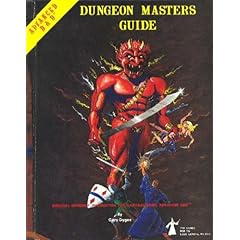
  • The First Edition DM's Guide, of which I do not have the fancy one pictured above, but instead the yellow spined edition that had some revisions to it, was a stream of consciousness walk through gaming philosophy, tables of random items and dungeons, and much much more. Not a practical guide by any stretch (not even its champions, myself included, would claim that) it was instead basically a brain dump by Gary Gygax of how gaming ideally works. Much fun is the random dungeon generator for solo play, as well as the artifcats that are still finding themselves used in games today.
  • The Second Edition DM's Guide was the weakest of the bunch. Neutering D&D to make it "adventure without danger" in reaction to a lot of the pressures of the 80s about the evils of roleplaying games (I'm using fairly broad strokes here - there were a lot of other factors to the revision), 2nd Edition started the trend of making the DMs guide slimmer than the Player's Handbook. Put the rules in the PHB, put the philosophy and commentary in the DMG. But, sadly, there was little of that in the 2nd edition guide, focusing more on magic items, etc.
  • The 3.5E DM's Guide (I don't have the 3e one), took a step back to offering more in the way of guidance, including a chart of 100 plot hooks that I still use, lots of advice about running games and creating adventures, as well as tons of info about how to DM. I think it may be the best of the WotC/TSR DM's guides.
  • The 3.5E Dungeon Master's Guide II, which I couldn't lay my hands on in the past few days - must be in a box somewhere, was a fantastic resource. Taking the 1E village of Saltmarsh and expanding it, building plot hooks for months of adventures, and statting out so much of it was tremendous. Perhaps even better was the advice on how to make a world living and breathing, including how to build out official factions. Now was this likely in reaction to what was happening in the video game world with factions as a way to relate to a game world? (See Oblivion, WoW, etc.) Likely yes, but the way to enact it for a tabletop RPG as well done, and made it something I started trying to do more and more of with the Ptolus campaign I was running when I purchased this book.
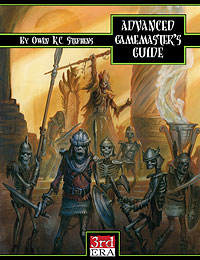
  • Not an official TSR/WotC product, but noteworthy nonetheless was Green Ronin's Advanced Gamesmaster's Guide. (Full disclosure - I playtested this for Green Ronin, and felt right from the start that it was going to be a fantastic product.) There was more keen advice in here than in any other product I'd seen to that point about how to be a good DM. Not just the stuff about "here's how to prep a published adventure," but stuff about roles in the playing group and how to address particular needs that different player types might have, how to craft scenarios to different play styles, and lots of great ideas for NPC behavior, plot hooks, and more. Great, great stuff.
  • Lastly, the 4th Edition DM's Guide. Now, I've been kind of hard on 4e. I still feel like the overall focus of making a game that is more relevant to the World of Warcraft gang (of which I'm happy to be an on-again-off-again member) takes away from the fun of "play" that previous editions had. ("Do you want to be a wizard or a fighter?" has been replaced with "Do you want to be a controller or the tank?" as I've stated before.) That said, the DM's guide does a good job in going over the mechanics of being a good DM - how to build good encounters, how to build quests, etc. I feel the overall system itself is too focused on the mechanics of 10 encounters are needed to level, and here's what should be in those encounters, and that sort of metagaming, but the result is what you make of it. I'm going to work hard to make a 4E sandbox where it's about the characters, not the stats and artillery roles. The way the book closes, with the introduction of the town of Fallcrest as an adventure starting point, does a good job to show what the game can be, and I hope more and more DMs embrace that.
I'm looking forward to a very role heavy version of roleplaying through the Forgotten Realms, in my new campaign. (No munchkins allowed, folks!) I'm also looking forward to the 4th Edition DMG II that is due out, focusing on running campaigns for characters levels 11-20. Bring it on WotC! I got some dice and am ready to game!

Friday, July 31, 2009

The Forgotten Realms in 4E: The Literature

I just finished reading Bruce R. Cordell's Plague of Spells (1385 DR - 1396 DR) and Richard Baker's Swordmage (1477 DR - 1479 DR), two of the earlier books in The Forgotten Realms pantheon to be set after the Spell Plague, which serves as the high water mark between the 3rd and 4th edition continuities of the classic shared fiction world. Other titles have covered the FR since the switchover to the new edition of Dungeons & Dragons, but these books opened up the first two big story arcs of the new era - The Abolethic Sovereignty and Blades of the Moonsea, respectively. In the non-literary world, I'm about to start my first 4th edition game of D&D set in the Forgotten Realms, starting a sandbox game in the Moonsea area using the 4e Forgotten Realms Campaign Setting and Player's Guide to the Forgotten Realms.

So, how are the books, and how do the help define the FR in 4E? Both were good, and in different ways. Cordell's Plague of Spells, the earlier set of the two titles, does perhaps the best job of explaining the Spell Plague of any of the texts I've read so far about 4th edition. He makes the experience of the (massively magically overpowered) world coming to an end and a new less pleasant world taking over seem real. Additionally, he does a great job making the characters more three dimensional than many other genre fiction titles, making Raidon's loss of a child something that sticks with the reader, Anusha's coming of age reminiscent for many of us, and Japheth's drug addiction a little more realistic than many books of its ilk might want to address. From both a game mechanics perspective and a literary perspective the apocalyptic removal of magical power from many of the Forgotten Realms' prominent figures helps address a problem this setting had suffered
under for over a decade - if there's a world full of massively overpowered beings, why would any other heroes be needed? (I know, but who will watch the watchmen?) Taking the power players down a peg helps give the other figures (player characters in the game, new characters in the books) take shape. The thing that I think Cordell did rather well within his book was keeping a few touch points from the earlier setting to help bridge the gap between "the old world" and the new era. Amongst these were characters from his book Stardeep, about a dungeon within the realms, and also cities and gods from the older campaign. Japheth as a young monk from Candlekeep before the fall was an interesting twist. (What happens to the folks who have spent their lives cataloging magic and knowledge when the world of magic shatters? Well, some would lose their way...)

Swordmage was a different animal. Set much further after the end of the spellplague, it was less concerned with how we got here, and much more about where we are now. There are still touchpoints back to the older setting - info about gods' names that had changed, cities that had been 3rd rate to Waterdeep are now larger players, the Elven kingdom of Myth Drannor has become whole again - but there are also some wholly new elements, like embedded pieces of the planet's lost sister world Abeir. The investigative plot line of SwordMage is fairly reminiscient of many of the stories associated with the Eberron campaign and literary setting. Eberron, the campaign world created by game designer Keith Baker, is a world of pulp mystery - think Chinatown with orc thugs and protagonists that are loners who reluctantly investigate murders. Geran, the main character in Swordmage, is a child of privilege who of course leaves all of that behind to travel the world. In his travels, he becomes entangled in scandal in the Elvish land of Myth Drannor, and after wandering for a while as an adventurer comes home to Hulburg, the kingdom ruled by his elderly uncle. Yes, this is the set up for every Princess Bride-esque tale to be told with Dungeons and Dragons as the mechanics for the telling, but Richard Baker does some clever things to not just tell the story, but make the reader interested in the new campaign world that the game is set in. It's no coincidence that the Forgotten Realms Campaign Setting opens with descriptions of the Moonsea area, where this novel is set, I'm sure. It also leaves enough plot hooks and introduces enough characters (NPCs in game parlance, for the uninitiated) to make for enough tales told around the game table using this novel as source material, much like many 1st edition gamers leveraged the Moonshae Isles books by Douglas Niles to start the first games based in the Forgotten Realms, more than 20 years ago. (Yes, I was one, sitting in my parents' living room after Christmas, and opening the gray box of the first FR Campaign Setting, and rolling up stats for NPCs while listening to Queen, with either the Niles books and the first R.A. Salvatore books, well dog eared by that point, within reach.)

The books are both worth reading, if you liked the FR books of years past or if you're planning on playing in or running a FR game that uses the 4th Edition setting. Cordell's book does a nice job of bridging the gap (I understand one of Salvatore's latest does a similar job), and Baker's Swordmage helps define one of the campaign areas that many players will rediscover this world through - the Moonsea. Both do the genre fiction world justice, and are better than other similar releases in other series. Most importantly, they keep a campaign world that had been stagnating a bit in recent history viable, and take it in new directions. I'll see you in the Realms.

Sunday, July 26, 2009

Wrapped up H2: Thunderspire Labyrinth - not as good as Keep on the Shadowfell...

I ran Keep on the Shadowfell for the D&D group that plays periodically at Timewarp Comics & Games, right as D&D 4E was released. The particular d&d group that was playing it there meets roughly once - sometimes twice - a month, so it took us a good 6 months to play through the whole thing. This was during the honeymoon period for me with Fourth Edition, when a lot of the new powers and class permutations seemed pretty novel and exciting. After DMing the game for a few months though, for different players, I started to feel a little differently, feeling that each combat was becoming repetitive. ("I use magic missile." "I use magic missile." "I use magic missile.") It seemed to me that despite the efforts to add new options to character classes, a weakness for some classes from1st Edition had reared its ugly head again - there are courses of action that are far more preferable for certain classes, and you'll use them over and over again, despite having other options. Magic Missile might have been the weapon of choice for a 1st level magic user in 1e because that was the most effective option, but at least by 4th level, you had a lot of other options. In 4E, after a wizard has blown their encounter power(s), they're still using magic missile a heck of a lot, even at level 8 or even higher...

So why did Keep on the Shadowfell work for me, aside from the honeymoon stage piece? Well, it was a well done module with lots of hooks for encounters and NPCs that weren't fleshed out. It was vaguely reminiscent of T1: The Village of Hommlet from early AD&D, in that the town itself was just as much the adventure as the encounters themselves - meet the town wizard, meet the innkeeper, etc. The end of the mod felt a bit like a railroaded closing to what had been a pretty promising adventure, but that's in my opinion a necessary evil of published adventures - they need to establish closure somehow, and if there are a lot of well defined plot hooks along the way, the closing sometimes can be a bit abrupt or have some urgency to it, just for architecture's sake.
My buddy Josh ran Thunderspire Labyrinth for the same group, though, and my feelings are not the same as they were for Shadowfell. Thunderspire Labyrinth had a lot of potential - the party saves slaves captured by evil Duergar - dark dwarves - in the Underdark, have to fight off a cult associate with an ancient Minotaur temple, and more. That said, this module seemed way more heavy on the encounters and factions that were pretty two-dimensional (we get it - Duergar are evil dwarves...) rather than providing an adventuring environment and NPCs that the PCs really had any interest in protecting. The concept of a town in a mountain was great, but I didn't feel like there were any strong hooks for making this place a home for the PCs - something I always look for in settings (create a place where the PCs wouldn't mind staying, and adventuring some more).

I have a lot of respect for Baker and Mearls, I just felt like after the wide-open, sandbox-y feel of Shadowfell that Thunderspire gave a lot more potential for play outside the pages of the module, whereas Thunderspire Labyrinth had some great scenes and ideas but was more of an adventure to play as a path to completing the Heroic Tier so that you could get on with the Paragon stuff.

We're going to play a sandbox game of Forgotten Realms as the next game with this group. I'll be DMing, and the party will find themselves in the Moonsea, leveraging a lot of the things I thought Baker has done well with the Swords of the Moonsea series, and giving the players an open ended world to play in.

What'd you think of H1 and H2? Is H3 worth incorporating into our game? Interestingly, I've seen lots of folks say they thought H2 was far better than H1. Discuss!